Anya Zhelud. Not That Horizon
Exhibition
05 June —
23 August, 2026
Entry ticket
₽
Concession ticket
₽
Monday
₽
Entry ticket
Concession ticket
Monday
On June 5, the AZ/ART Center for Contemporary Art will open the exhibition Anya Zhelud.Not That Horizon, about a key figure in Russian contemporary art.
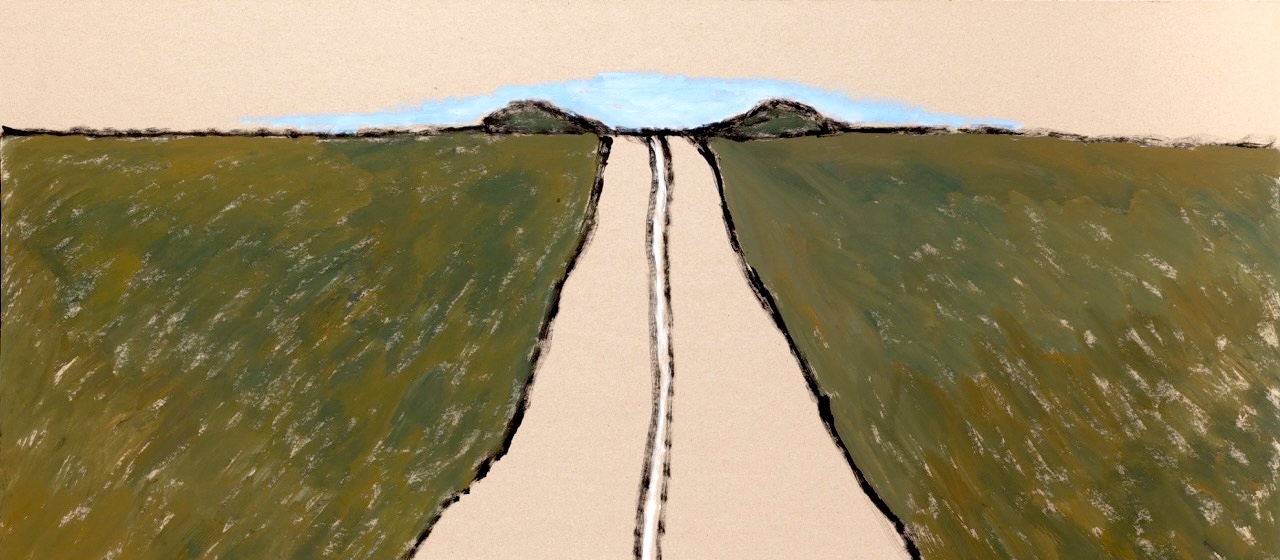
The project will focus on Zhelud's paintings, bringing them together with objects and installations to show how her artistic method evolved over the course of her life. The exhibition will present works spanning a quarter-century of the artist's career, including paintings from 2000–2001 that have never been shown before. At its core are works from the AZ Museum collection and from the collection of Sergey Alexandrov, who was one of the first to recognize the significance of her painting and supported Anya Zhelud for many years.
Создатели выставки
"An artist who finds herself a hostage to the world of objects becomes more transparent, more incorporeal. She turns into a person who is not there, she becomes a territory of love for things — a person who is yet to be." Anya Zhelud wrote these words in 2006, when she was 25 and just entering the world of contemporary art. According to the exhibition's curator Irina Gorlova, they precisely describe both the artist's method and her fate — a road that was at first a true highway carrying her toward success and recognition, only to be turned aside, by the circumstances of life, onto the shoulder. The opening date of the project was not chosen by chance: exactly one year ago, on June 4, 2025, the artist passed away.
The exhibition will focus on Anya Zhelud's paintings and trace the evolution of her artistic method: from rich, "polyphonic" painting — through austere monochrome landscapes — to colorless works and metal installations, in which volume turns into space and the painting becomes one "you can walk into."
The project will be devoted to two themes that form an important part of Zhelud's art — home and road, the world within and the world outside. The exhibition's title, Not That Horizon, is borrowed from a series of minimalist landscapes Anya created in tempera on cardboard in 2020. The "horizon," according to Hans-Georg Gadamer, the founder of philosophical hermeneutics, is "the field of vision that encompasses and embraces everything that can be seen from a particular vantage point." Anya Zhelud's "horizon" shifted at different periods of her life — both its starting vantage point and its "field of vision" — moving from a confined "inner circle" to a road that gradually loses the familiar markers of the real world along the way.
"Not that artist" — this is how Anya described herself while working on a project with scientists who were trying to determine whether she had a "model of the world." In the end, in her search for that model, the "not-that-artist" Anya Zhelud crossed the line of the "not-that-horizon."
The exhibition, designed by architect Alexey Podkidyshev, is built as a sequential journey through three rooms, each of which reveals one of the key motifs of Anya Zhelud's artistic language. From the dense world of objects in the first room — with things, still lifes, and ceramics — the eye moves on to landscapes, where space gradually thins out and color almost disappears. In the finale, line becomes the main protagonist: in paintings and metal objects it takes the place of things, turning them into light, almost weightless constructions.
'%20fill='black'/%3e%3cpath%20d='M0.5%205.32825C0.50008%204.93053%200.65822%204.54893%200.939453%204.2677L3.43945%201.7677C4.0252%201.18211%204.9748%201.18211%205.56055%201.7677L8.06055%204.2677C8.34178%204.54893%208.49992%204.93053%208.5%205.32825L8.5%208.50012L0.5%208.50012L0.5%205.32825Z'%20stroke='black'/%3e%3c/svg%3e)
'%20fill='%23FFF903'/%3e%3cpath%20d='M0.5%205.32825C0.50008%204.93053%200.65822%204.54893%200.939453%204.2677L3.43945%201.7677C4.0252%201.18211%204.9748%201.18211%205.56055%201.7677L8.06055%204.2677C8.34178%204.54893%208.49992%204.93053%208.5%205.32825L8.5%208.50012L0.5%208.50012L0.5%205.32825Z'%20stroke='%23FFF903'/%3e%3c/svg%3e)
'%20fill='%23646464'/%3e%3cpath%20d='M0.5%205.32825C0.50008%204.93053%200.65822%204.54893%200.939453%204.2677L3.43945%201.7677C4.0252%201.18211%204.9748%201.18211%205.56055%201.7677L8.06055%204.2677C8.34178%204.54893%208.49992%204.93053%208.5%205.32825L8.5%208.50012L0.5%208.50012L0.5%205.32825Z'%20stroke='%23646464'/%3e%3c/svg%3e)