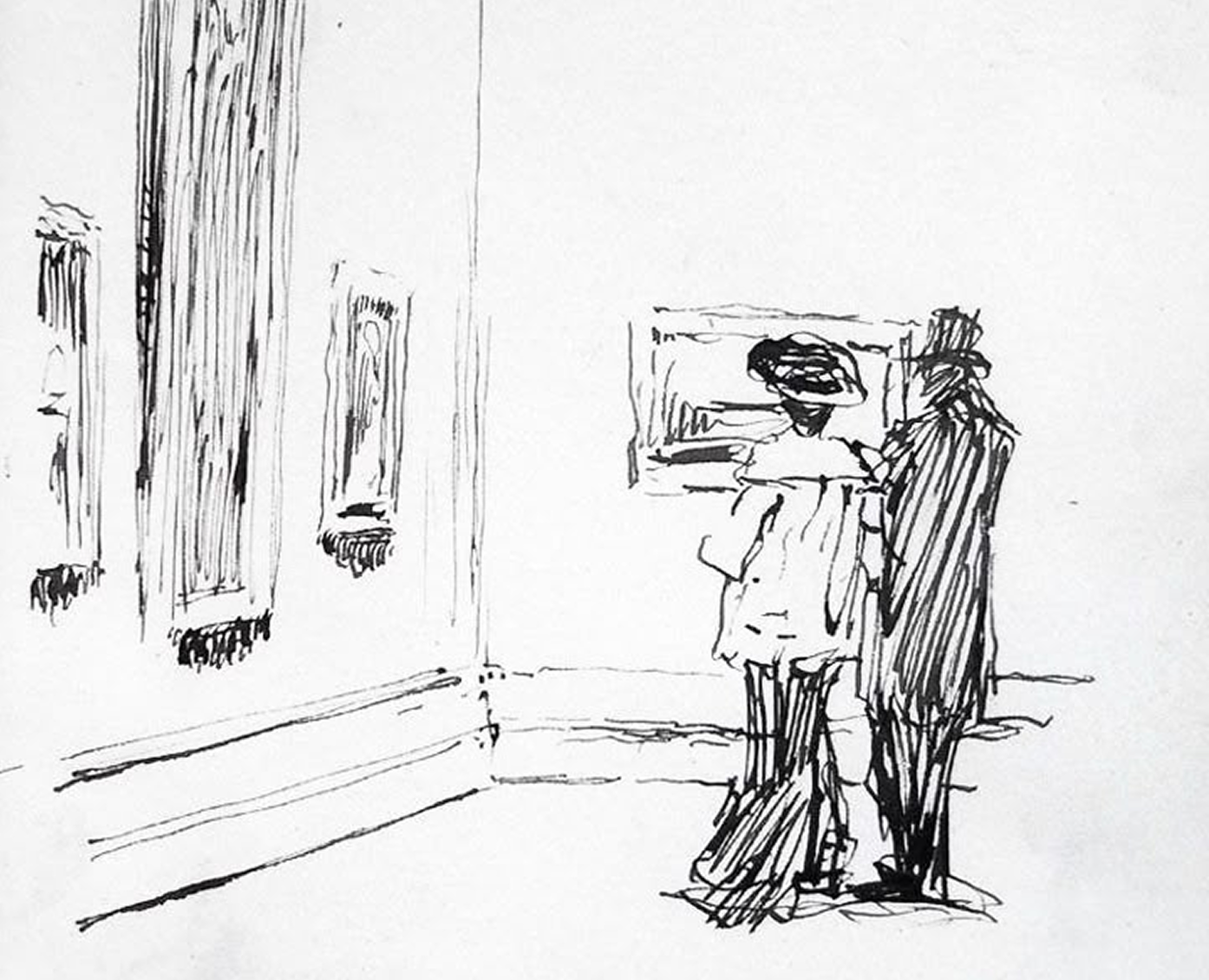

The Exhibition “Literal Connections” Opened at the AZ/ART Center for Contemporary Art
Media / News
03 November, 2024
On March 12, 2025, the exhibition “Literal Connections” opened at the AZ/ART Center for Contemporary Art. The exhibition is dedicated to Anatoly Belkin’s exploration of the meaning-laden gap between the artist’s artistic and behavioural pattern and one of the central themes of his art — the erosion of the cultural layer and the fragmentation of memory.
“Literal Connections”
The exhibition brought together more than 70 paintings, graphic works, and sculptures by the artist from the collections of the AZ Museum and private collections. The exhibition is dedicated to Belkin’s exploration of the meaning-laden gap between the artist’s artistic and behavioural pattern and one of the central themes of his art — the erosion of the cultural layer and the fragmentation of memory.
#CREATORS#Anatoly Belkin is an artist, cultural figure, mystifier, participant in the first exhibitions of unofficial art in Leningrad in the 1970s, and founder of the St Petersburg magazines “Sobaka.ru” and “Veshch.doc.” Today, his works are held in the Hermitage, the Russian Museum, the Stedelijk Museum Amsterdam, and other museums around the world. Since the late 1980s, the artist’s solo exhibitions have been held in galleries in New York, Paris, London, and Berlin; in 2004, Belkin’s exhibition “Gold of the Swamps,” a grand project about a fictional “swamp civilization,” became a breakthrough for contemporary Russian art at the Hermitage. In Moscow, however, the artist had only one exhibition over the course of his career — in 2006 at Triumph Gallery, where the project “Gold of the Swamps” was again shown in collaboration with the Hermitage.
#VIDEO#Vitaly Pushnitsky is one of Russia’s leading contemporary artists, whose works are widely known beyond the country. He was born in St Petersburg in 1967 and studied at the Academy of Arts. Pushnitsky works across various media, including painting, graphic art, installations, and video art, exploring themes of time, space, memory, and sound. His projects have repeatedly taken part in major international exhibitions, including the Moscow Biennale of Contemporary Art and the Venice Biennale.
The artist actively uses sound as an important component of his works, exploring its influence on the perception of space and its interaction with other media. In Pushnitsky’s works, sound often becomes a metaphor for time, memory, and communication, something especially vivid in his portraits and installations.
#MEDIA_1#Vitaly Pushnitsky is one of Russia’s leading contemporary artists, whose works are widely known beyond the country. He was born in St Petersburg in 1967 and studied at the Academy of Arts. Pushnitsky works across various media, including painting, graphic art, installations, and video art, exploring themes of time, space, memory, and sound. His projects have repeatedly taken part in major international exhibitions, including the Moscow Biennale of Contemporary Art and the Venice Biennale.
The artist actively uses sound as an important component of his works, exploring its influence on the perception of space and its interaction with other media. In Pushnitsky’s works, sound often becomes a metaphor for time, memory, and communication, something especially vivid in his portraits and installations.
#MEDIA_2# He was born in St Petersburg in 1967 and studied at the Academy of Arts. Pushnitsky works across various media, including painting, graphic art, installations, and video art, exploring themes of time, space, memory, and sound. His projects have repeatedly taken part in major international exhibitions, including the Moscow Biennale of Contemporary Art and the Venice Biennale.
#GALLERY_1#
Boris Grebenshchikov and his band Aquarium have always stood apart on the Soviet rock scene. Their music combined philosophical lyrics, deep cultural references, and musical experimentation.
The album “Triangle” (1981) became one of the first tape albums recorded on home equipment. This archive contains rare recordings of concerts and rehearsals that were not available to a wider audience.
Boris Grebenshchikov and his band Aquarium have always stood apart on the Soviet rock scene. Their music combined philosophical lyrics, deep cultural references, and musical experimentation. The album “Triangle” (1981) became one of the first tape albums recorded on home equipment. This archive contains rare recordings of concerts and rehearsals that were not available to a wider audience.
Boris Grebenshchikov and his band Aquarium have always stood apart on the Soviet rock scene. Their music combined philosophical lyrics, deep cultural references, and musical experimentation. The album “Triangle” (1981) became one of the first tape albums recorded on home equipment. This archive contains rare recordings of concerts and rehearsals that were not available to a wider audience. Boris Grebenshchikov and his band Aquarium have always stood apart on the Soviet rock scene.
Boris Grebenshchikov and his band Aquarium have always stood apart on the Soviet rock scene. Their music combined philosophical lyrics, deep cultural references, and musical experimentation. The album “Triangle” (1981) became one of the first tape albums recorded on home equipment. This archive contains rare recordings of concerts and rehearsals that were not available to a wider audience. Boris Grebenshchikov and his band Aquarium have always stood apart on the Soviet rock scene. Their music combined philosophical lyrics, deep cultural references, and musical experimentation. The album “Triangle” (1981) became one of the first tape albums recorded on home equipment. This archive contains rare recordings of concerts and rehearsals that were not available to a wider audience.
#QUOTE#In truth, it seems to me that the division into the Moscow and St Petersburg schools is very conditional. In the 1960s, or the 1990s, or the 2000s, one can find far more similarities between Moscow artists and their St Petersburg contemporaries than between Moscow artists of this generation and those of the previous one. It is hardly possible to trace clear lines and a definite continuity here. In Russian art history in general, continuity is extremely complicated; it is the scarcest commodity. And this is true of the post-Soviet space as a whole.
What we have is rather a decorative kind of continuity. We dislike being ourselves so much that we want to return to some imagined authenticity. And we want to lean on the figure of a teacher so that it would ground us, justify us, and give our existence rootedness and confidence — although in fact this is an entirely therapeutic construct that allows us not to suffer so intensely from the horror of life.
#GALLERY_2#One of the key figures of the rock underground was Mike Naumenko, leader of the band Zoopark.
The exhibition “The Third Ear,” in which Vitaly Pushnitsky presented one of his most recent works — a metaphorical portrait of John Cage — explores the interaction between sound and visual art. The project examines how music penetrates everyday life and becomes material for artistic reflection. Pushnitsky’s works in the exhibition reflect his investigation of sound as a phenomenon capable of moving beyond aural impressions and taking shape in material forms. Using abstract visual images, he seeks to convey to viewers the atmosphere of music and the sonic nature of the world, embodied in various materials.
#TABLE#
Creating a portrait of John Cage, Vitaly Pushnitsky immerses himself in the philosophy of this composer, who became an icon of experimental music and is known for his radical views on sound and silence. The portrait embodies reflections on Cage’s influence on contemporary art and on his unique ability to transform immaterial sound into an artistic object.
List with bullet highlighting inside regular text:
- Concert hall;
- Exhibition of contemporary art;
- May at any time update, block, or delete their personal data in the personal profile of the Site if such data are incomplete, outdated, inaccurate, obtained unlawfully, or are not necessary for the stated purposes of processing.
His style, close to Western blues rock, and his lyrics, often satirical and filled with subtle irony, made him a cult figure. One of the rarest and most valuable recordings is the tape album “Sweet N and Others,” in which each track immerses the listener in the atmosphere of the Leningrad rock scene of the 1980s.
List with a Subheading:
- Concert hall;
- Exhibition of contemporary art;
- Nobel Prize.
His style, close to Western blues rock, and his lyrics, often satirical and filled with subtle irony, made him a cult figure. One of the rarest and most valuable recordings is the tape album “Sweet N and Others,” in which each track immerses the listener in the atmosphere of the Leningrad rock scene of the 1980s.
- We will get acquainted with artists and portraits created by Leonardo;
- We will learn how true geniuses overcome space and gravity;
- We will find where the soul lives and assemble a moving robot-human.
Material taken from the website of Rossiyskaya Gazeta — an example of link highlighting.
Share

'%20fill='black'/%3e%3cpath%20d='M0.5%205.32825C0.50008%204.93053%200.65822%204.54893%200.939453%204.2677L3.43945%201.7677C4.0252%201.18211%204.9748%201.18211%205.56055%201.7677L8.06055%204.2677C8.34178%204.54893%208.49992%204.93053%208.5%205.32825L8.5%208.50012L0.5%208.50012L0.5%205.32825Z'%20stroke='black'/%3e%3c/svg%3e)
'%20fill='%23FFF903'/%3e%3cpath%20d='M0.5%205.32825C0.50008%204.93053%200.65822%204.54893%200.939453%204.2677L3.43945%201.7677C4.0252%201.18211%204.9748%201.18211%205.56055%201.7677L8.06055%204.2677C8.34178%204.54893%208.49992%204.93053%208.5%205.32825L8.5%208.50012L0.5%208.50012L0.5%205.32825Z'%20stroke='%23FFF903'/%3e%3c/svg%3e)
'%20fill='%23646464'/%3e%3cpath%20d='M0.5%205.32825C0.50008%204.93053%200.65822%204.54893%200.939453%204.2677L3.43945%201.7677C4.0252%201.18211%204.9748%201.18211%205.56055%201.7677L8.06055%204.2677C8.34178%204.54893%208.49992%204.93053%208.5%205.32825L8.5%208.50012L0.5%208.50012L0.5%205.32825Z'%20stroke='%23646464'/%3e%3c/svg%3e)